 |
 |
3 |
 |
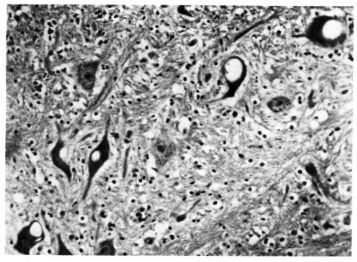
sheep or goat tissues.8 The most important contribution of the mink model of scrapie disease has been to further our knowledge on the development of spongiform degeneration in the brain. These diseases are all characterized pathologically by microvacuolation of the neuropil (Figure 1A) accompanied by reactive astrocytic hypertrophy (Figure 1B). Ultrastructurally, the vacuolation is produced by dilations in axons and nerve cell bodies (Figure 1C). However, studies on TME in mink homozygous for the Aleutian gene have shown conclusively that the spongiform degeneration is a secondary effect of the disease process and probably produced by lysosomal enzymes.’° Therefore, the only primary lesion remaining is neuronal degeneration (Figure 2), but the method of cell injury remains unknown.
Significance
to
Creutzfeldt-Jakob Disease
Studies on the animal models of scrapie and TME will provide critical information on the biophysical nature of these pathogens and on their mechanisms of infection and progression in the host. These results can then be applied to animal models of the human disease and, eventually, to infected human tissues.
References
gressive pneumonia of sheep: Epizootiological and pathological study. II. Paratuberculosis (Johne’s disease) of sheep in Iceland: Immunological studies and observations on its mode of spread. III. Rida, chronic encephalitis of sheep, with general remarks on infections which develop slowly and some of their special characteristics. Brit Vet J 110:7-9, 225-270, 307-322, 341-354, 1954
form encephalopathy. J Wildi Dis, 16:89-98, 1980
in the hamster. J Gen Virol 34:295-304, 1977
|
|
Fig 2— Neuronal degeneration in brain stem of a mink with transmissible mink encephalopathy. (H&E, x 800.)
|
|
|
3 |
|